
How to Think Critically: A Field Guide for Hard Problems
Key Takeaways
- Critical thinking is not cynicism: Cynicism rejects claims reflexively to preserve disbelief, whereas critical thinking suspends certainty to investigate what earns belief.
- The fluency trap: Syntactic fluency and cognitive ease substitute the effortless question (“Does this sound coherent?”) for the demanding question (“What is the underlying causal mechanism?”).
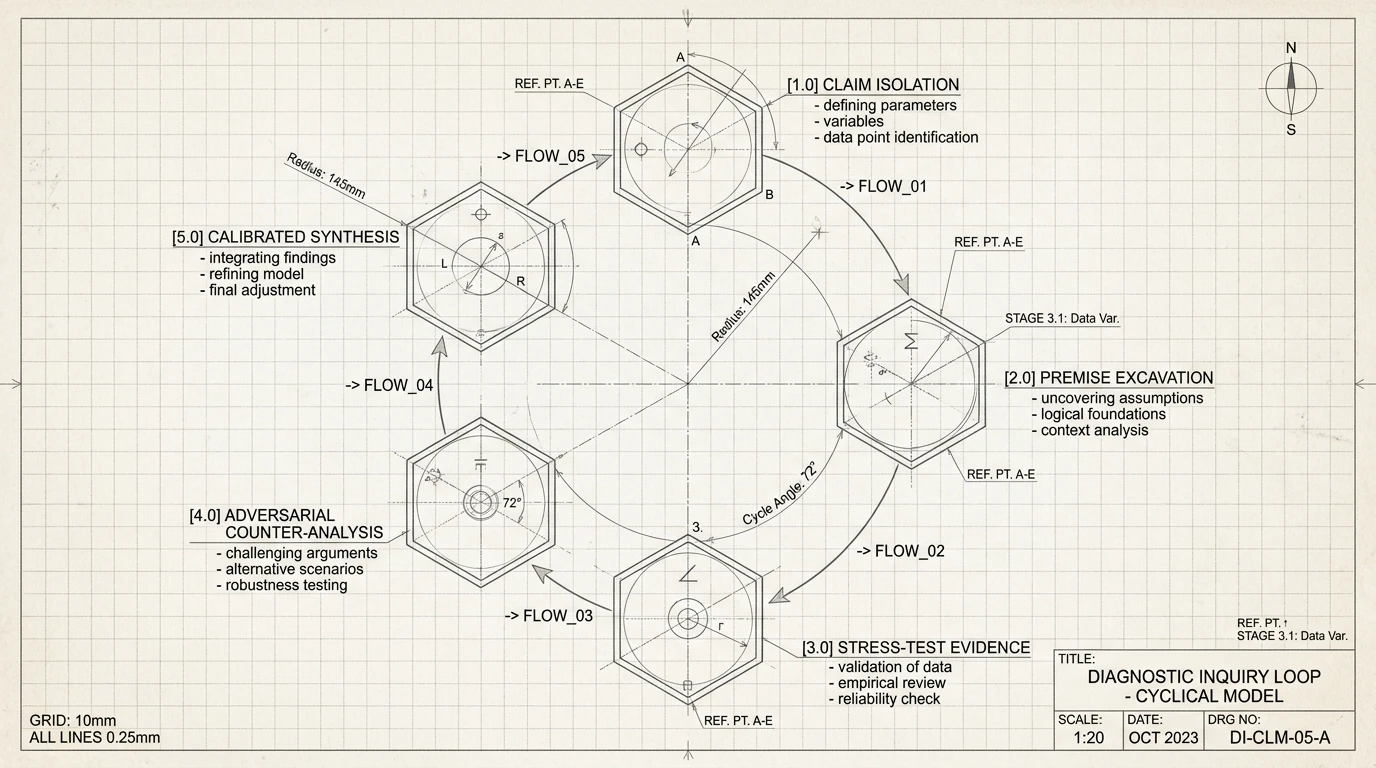
- The 5-stage diagnostic framework: Move systematically through claim isolation, premise excavation, evidence stress-testing, adversarial counter-analysis, and calibrated conviction.
- Submerged premises sink decisions: Strategic failures rarely stem from arithmetic errors on visible facts. They occur when teams build upon unexamined environmental, causal, and behavioral assumptions.
- Pre-commit to decision tripwires: Set explicit quantitative rollback thresholds before implementation begins to neutralize post-hoc rationalization and motivated reasoning.
Most bad decisions do not look like bad decisions when someone makes them. They look like sensible conclusions drawn from compelling presentations.
Someone walks into a boardroom or posts in an engineering channel with a polished proposal. The vocabulary is modern, the graphs trend upward, the executive summary is clean, and the speaker answers initial questions without hesitation. Everyone nods. Two quarters later, the project is quietly canceled after burning six months of engineering bandwidth, degrading user trust, and introducing technical debt that takes a year to unwind.
When the autopsy is conducted, the diagnosis is rarely that someone could not do basic math. The failure is almost always architectural. Nobody isolated the core empirical claim from the persuasive rhetoric. Nobody excavated the submerged operational assumptions required for the proposal to succeed. Nobody asked what observable evidence would prove the idea wrong before shipping it to production.
In our everyday information environment, this vulnerability is accelerating. The human mind did not evolve to parse high-velocity synthetic text, algorithmic feeds optimized for emotional resonance, and enterprise pitch decks designed to maximize cognitive ease. When information flows smoothly, our default setting is to accept it.
Critical thinking is the deliberate suspension of that default setting. It is not an innate personality trait, and it is certainly not cynicism. Cynicism is cheap: it rejects every proposal out of hand to guard against being fooled, ending inquiry before it starts. Critical thinking is demanding: it accepts that a claim might be true, but insists on doing the structural engineering work to verify whether the argument can actually bear weight.
This guide provides an operational diagnostic runbook for that engineering work. It breaks critical analysis into a five-stage diagnostic loop, demonstrated end-to-end through a single high-stakes scenario that technical leaders and engineers encounter every week.
The Modern Thinking Deficit: Cognitive Ease and the Fluency Trap
To understand why critical thinking feels so unnatural, we have to look at the energetic economics of human cognition.
In Thinking, Fast and Slow (2011), Daniel Kahneman synthesized decades of research showing that the brain operates under a principle of least effort. When faced with a complex, cognitively expensive question, such as “Is this operational architecture robust against unexpected distributional shift?”, the subconscious mind quietly substitutes an easier question: “Does this explanation feel coherent and easy to process?”
Cognitive psychologists refer to this phenomenon as the fluency heuristic or processing fluency (Alter & Oppenheimer, 2009; Schwarz, 2004). When information is presented with clear typography, symmetrical sentence structures, familiar jargon, and confident cadence, our brains register low cognitive friction. We mistake that absence of friction for an index of truth. If a narrative glides smoothly through working memory, we instinctively assume the underlying reality must be equally sound.

| Mode | Processing Channel | Cognitive Experience | Diagnostic Outcome |
|---|---|---|---|
| Surface Fluency | Polished tone, familiar buzzwords, high cadence | Low mental friction (Cognitive Ease) | Default uncritical acceptance; hidden flaws go undetected |
| Critical Scrutiny | Stripped rhetoric, edge-case probing, primary audits | Deliberate metabolic effort (Active Friction) | Calibrated conviction based on verified mechanisms |
Generative AI has turned this psychological blind spot into a systemic crisis. Large language models are optimization engines for syntactic fluency. By predicting high-probability token sequences, they generate authoritative, beautifully balanced prose across any topic in milliseconds.
Yet as we explored in Evaluating the Unpredictable: Why and How Evals Should Work in Agentic AI, a model has no built-in sensory contact with physical reality, no stake in operational consequences, and no inherent mechanism that prevents plausible nonsense from masquerading as fact. Fluency has become virtually free and infinitely abundant. Verification, meanwhile, remains expensive, scarce, and strictly manual.
If you rely on your intuitive sense of plausibility to evaluate arguments today, you will be systematically misled by whoever or whatever produces the smoothest text. To protect yourself and your organization, you need an explicit protocol that forces friction back into the loop.
The 5-Stage Critical Thinking Framework
To make critical inquiry practical, we need a disciplined method that operates like a compiler or a linter for human thought.
We will walk through this framework using a realistic, high-stakes anchor case study:
The Proposal Under Review:
“Our enterprise SaaS customer support costs are unsustainable. We should immediately decommission our 40-person Tier-1 support team and replace them with an autonomous, LLM-powered agent. The vendor’s pilot demonstrates a 92% resolution rate, instant first-response times, and an estimated 80% reduction in customer operations expenditure.”
This proposal sounds decisive, forward-looking, and economically irresistible. Let us run it through the five stages.
Stage 1: Isolate the Claim (Stripping the Persuasive Armor)
Every serious proposal arrives wrapped in persuasive armor. This armor consists of emotional appeals, prestige cues, industry buzzwords, and bundled assertions designed to make dissent feel retrograde.
The objective of Stage 1 is propositional reduction: strip away every adjective, authority cue, and rhetorical flourish until only bare, falsifiable assertions remain.
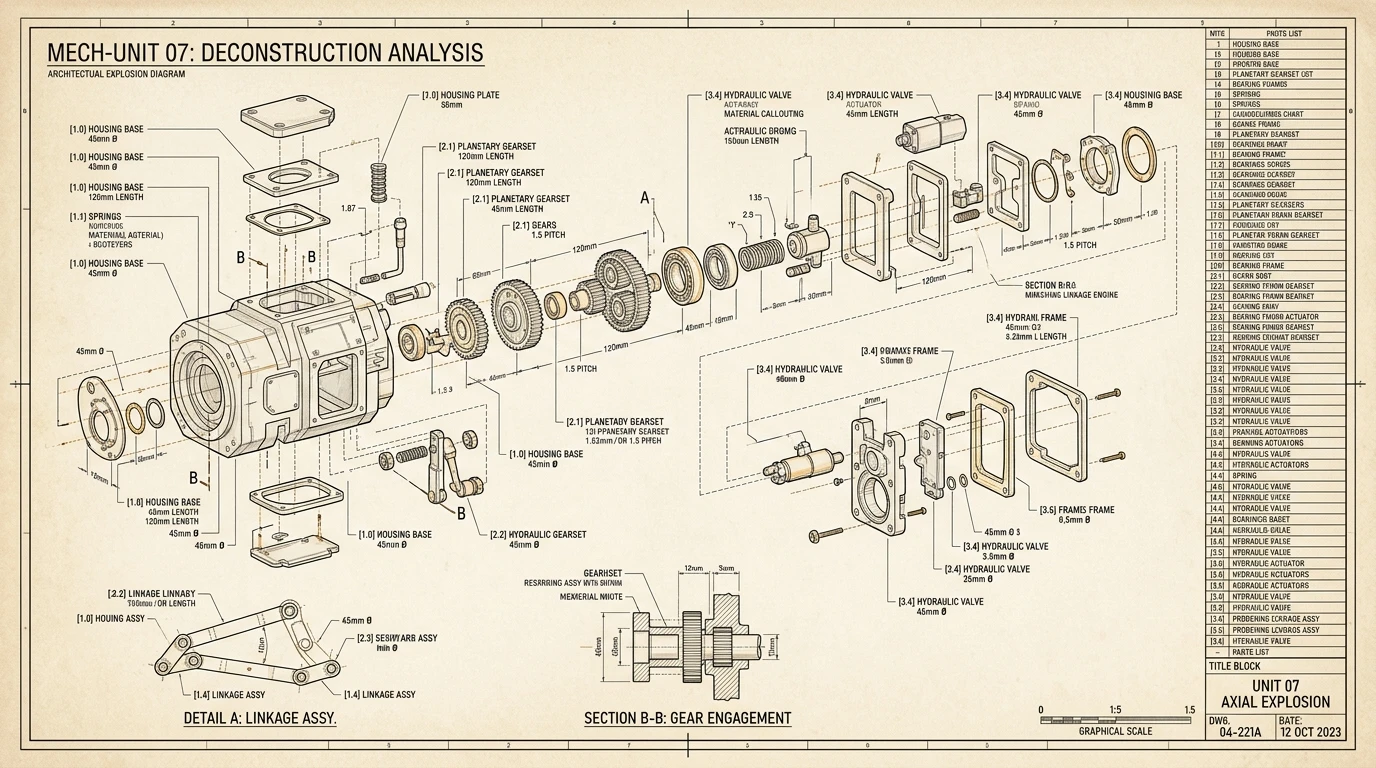
Notice what happens when we translate the vendor’s pitch into raw logic. The proposal is not a single decision; it is a bundle of three independent empirical claims:
- Claim A (Operational Capability): The automated agent resolves customer inquiries with accuracy and satisfaction equal to or greater than trained human staff.
- Claim B (Systemic Safety): Complete replacement will not increase customer churn, escalate second-tier support load, or degrade product engineering telemetry.
- Claim C (Net Economics): Total operational expenditure (including model tokens, guardrail software, database hosting, exception handling, and vendor licensing) will be lower than current payroll.
Separating the bundle is crucial because advocates routinely use evidence for Claim A to slip Claims B and C past scrutiny without proof. Showing that a bot answered a demo prompt does not prove that customer churn will remain stable or that total system costs will fall.
Before proceeding to any debate, force the conversation onto the deconstructed claims:
- What exact proposition is being asserted?
- Which words in the proposal are factual descriptions, and which are rhetorical persuasion?
- If this proposal consists of multiple claims, what are they when separated?
Stage 2: Excavate Hidden Premises (Finding the Submerged Iceberg)
An argument is an iceberg. The explicit claim and visible metrics sit above the waterline, but the entire weight of the conclusion rests upon submerged premises that are rarely stated aloud.
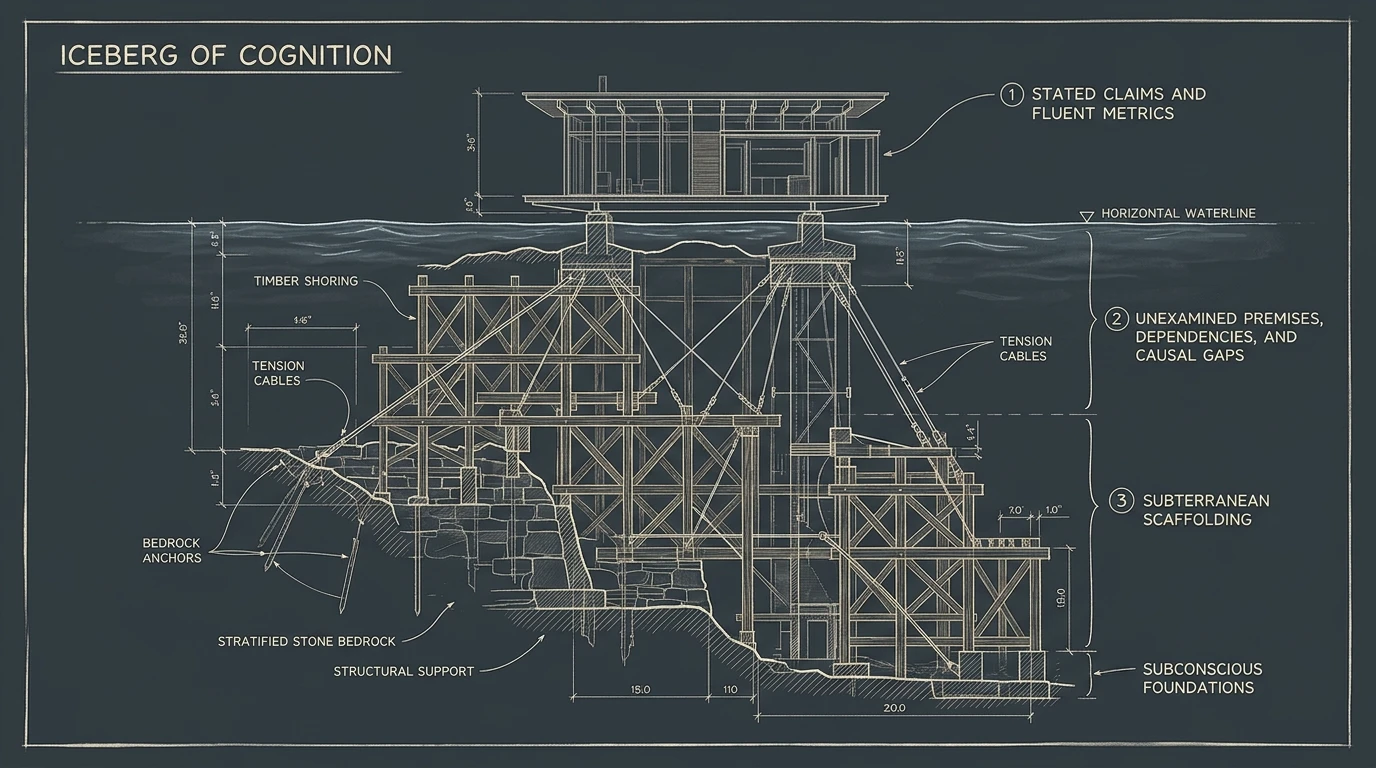
A premise is an unstated condition that must hold true for the conclusion to follow from the evidence. If the premise is false, the conclusion collapses even if the visible arithmetic is spotless.
To excavate hidden premises systematically, categorize them across three dimensions:
| Premise Category | Diagnostic Question | What It Uncovers |
|---|---|---|
| Environmental | What external conditions are assumed to remain static? | Invariant market conditions, stationary data distributions, platform stability. |
| Causal | What mechanism is assumed to connect the action to the result? | Proxies mistaken for outcomes, intermediate steps assumed to be frictionless. |
| Behavioral | How are humans assumed to react to this intervention? | User adaptations, workaround behaviors, organizational moral hazard. |
Let us excavate the submerged premises supporting our customer support replacement proposal:
Hidden Premise 1 (Causal): “Ticket Closure” Equals “Customer Issue Resolved”
The vendor reports a “92% resolution rate.” But how does the software define resolution? In automated ticketing systems, resolution often means the user did not reply within 48 hours of an automated response.
The hidden causal premise is that customer silence signifies success. In practice, a customer who receives an unhelpful, repetitive automated reply often closes the tab in disgust, writes off the product, and begins evaluating a competitor. The metric registers a successful resolution; the business suffers customer churn.
Hidden Premise 2 (Environmental): All Operational Knowledge Is Documented
The proposal assumes the knowledge base and API documentation contain everything needed to service customer inquiries.
In reality, customer support teams rely on a massive foundation of unwritten tribal knowledge. Human agents know that when a customer complains about error code 504 on a Tuesday morning, it is not a client-side network error; it is an unannounced database migration running in the European region. Human agents bridge the gap between idealized documentation and chaotic production reality. Replacing them assumes our documentation is comprehensive, accurate, and perpetually up to date. It never is.
Hidden Premise 3 (Behavioral): Support Only Answers Questions
The proposal treats customer support as an isolated expense center whose sole function is message deflection.
This ignores a critical organizational feedback loop: Tier-1 support functions as the company’s frontline radar. When a bad code deployment breaks an obscure checkout flow, support agents notice five similar complaints within twenty minutes and raise an urgent incident in Slack. They translate raw user confusion into actionable bug reports for engineering. If you replace that frontline with an automated bot that treats every interaction as an isolated session, you sever the product team’s primary nervous system.
In Critical Thinking: The Architecture of Doubt, we noted that systematic doubt is the practice of inspecting what holds a belief up before deciding whether to trust it. When you excavate these three premises, the proposal looks radically different. The question is no longer “Can an AI bot draft text?”, but rather “Can we survive disconnecting our customer feedback loops while relying on undocumented operational knowledge?”
Stage 3: Stress-Test the Evidence (Verification vs. Plausibility)
Once you understand what claims are being made and what premises they depend upon, you must scrutinize the evidence offered in support.
The governing rule of evidence is simple: Plausibility is not proof. A plausible explanation makes intuitive sense; verified evidence has survived hostile contact with reality.
| Audit Dimension | Core Imperative | Failure Mode It Prevents |
|---|---|---|
| Primary Sources | Demand raw, uncurated production transcripts | Accepting benchmark overfitting and synthetic test data |
| Causal Mechanisms | Disentangle true resolution from metric deflections | Confusing quick ticket closure with actual customer satisfaction |
| Falsification Threshold | Pre-commit to observable conditions that refute the claim | Unfalsifiable rationalizations and moving goalposts |
Three diagnostic tools allow you to stress-test evidence rapidly:
1. The Primary Source Rule
Never accept summarized benchmarks, secondary case studies, or vendor-supplied dashboards at face value. Always inspect the raw data and collection methodology.
In our support automation case, demand the raw evaluation transcripts from the vendor’s 92% resolution pilot. When you inspect the individual logs, what do you find?
- Did the pilot test against real production tickets, or did the vendor feed the model synthetic, hand-crafted queries?
- Were ambiguous, angry, or multi-part customer questions included, or did the sample consist primarily of basic password resets?
- Who evaluated the correctness of the responses: actual domain specialists or crowd-sourced evaluators following a loose rubric?
As we analyzed in AI Benchmark Cheating: Question the Goal, whenever an evaluation metric becomes a target, it is systematically gamed. Without inspecting raw primary logs, you cannot know whether you are looking at genuine competence or benchmark overfitting.
2. Disentangle Mechanism from Correlation
When data indicates a positive outcome, ask: what exact causal mechanism produced this number?
Suppose the vendor points to a trial at another enterprise where average ticket handle time dropped from 14 minutes to 30 seconds after deploying their agent. Handle time did drop, but why?
- Mechanism A: The agent resolved the underlying problem twenty-eight times faster than a human.
- Mechanism B: The agent dumped a generic help center link into the chat window and terminated the session.
Both mechanisms produce an identical handle time metric on an executive dashboard. Only one of them solves the customer’s problem.
3. Establish the Falsification Condition
Following the philosopher of science Karl Popper (The Logic of Scientific Discovery, 1959), an empirical hypothesis is only meaningful if it specifies what observable observation would prove it wrong. If a proponent cannot tell you what evidence would convince them to abandon their proposal, they are advancing an article of faith, not a reasoned strategy.
For our support proposal, formulate the falsification condition explicitly:
“If a double-blind audit of 300 production tickets demonstrates that the automated agent introduces factual inaccuracies, hallucinations, or unhandled customer frustration on more than 4% of interactions, the hypothesis of direct autonomous replacement is falsified.”
Stage 4: Run Adversarial Counter-Analysis (The Steel Man)
Most people critique ideas through straw-manning: attacking the weakest, silliest version of an argument to guarantee an effortless intellectual victory. Straw-manning feels gratifying, but it leaves you completely unprepared when reality presents the stronger version.
Critical thinkers do the opposite: they steel-man opposing views. You construct the most formidable, articulate, and well-evidenced version of the counter-thesis before rendering judgment.

| Mode | Argument Construction | Epistemic Result |
|---|---|---|
| Straw-Man Critique | Attacks trivial caricatures (for example, dismisses proposals as mere hype bubbles) | Shallow feeling of intellectual victory; remains blind to real catastrophic risks and genuine advantages |
| Steel-Man Counter-Analysis | Formulates the strongest, most formidable counter-thesis (for example, maps correlated systemic failure cascades) | Uncovers hidden structural vulnerabilities and defines robust operational boundaries |
Steel-Manning the Opposition: What Is the Strongest Argument Against Replacement?
To run an adversarial counter-analysis against the support automation proposal, do not simply say “AI makes mistakes.” Map the second-order systemic failure modes:
- Correlated Tail-Risk at Scale: Human agents make mistakes, but their errors are uncorrelated: agent Alice might misquote a policy on ticket 104, while agent Bob handles ticket 105 correctly. An automated agent shares identical system prompts, tool definitions, and weights across all concurrent sessions. If an edge-case prompt injection or unexpected API regression causes the model to hallucinate a 100% refund policy or leak sensitive tenant data, that defect executes across ten thousand tickets simultaneously within seconds.
- Severing the Organizational Talent Pipeline: Support teams are an organization’s internal university. A significant percentage of junior support representatives develop deep product intuition and eventually transition into product management, quality assurance, solutions engineering, and customer success. Completely dismantling Tier-1 support saves short-term operational expenditure, but destroys the company’s internal talent engine.
- The Customer Escalation Asymmetry: When a user interacts with a human and experiences a minor delay, they attribute it to an individual having a busy day. When a user is trapped in an unhelpful loop with an automated bot that refuses to escalate to a human, they attribute it to corporate indifference. The psychological cost to brand equity is asymmetric.
Steel-Manning the Original Proposal: What Is the Strongest Argument For Replacement?
To avoid falling into reflexive conservatism, steel-man the proposal as well:
- Human Tier-1 support has profound failure modes: high employee turnover (often exceeding 60% annually), inconsistent responses across shifts, slow coverage during weekends and holidays, and high cognitive fatigue on repetitive tasks.
- For well-bounded, deterministic tasks (e.g., resending an invoice, generating a password reset link, confirming an enterprise compliance certificate), an automated system provides instant resolution at 3:00 AM on a Sunday, genuinely delighting the customer.
This adversarial analysis reveals that the debate was framed incorrectly from the beginning. The choice is not a binary decision between “replace all humans” and “reject all automation.” The real problem is determining the exact operational boundary where automation improves service without introducing correlated systemic catastrophe.
Stage 5: Form Calibrated Conviction and Decision Tripwires
The final stage of the framework synthesizes our analysis into decisive action.
Amateur thinkers treat belief as a binary switch: an idea is either completely true or completely false. Professional thinkers treat belief as a continuum: they assign calibrated confidence levels based on the quality of available evidence.
When evaluating hard problems under uncertainty, you rarely have sufficient data for absolute certainty. The goal is calibrated conviction: acting decisively on your best current assessment, while establishing explicit operational mechanisms to detect when you are wrong.
The most powerful tool for maintaining calibrated conviction is the decision tripwire.
The Architecture of a Decision Tripwire
A tripwire is a quantitative, non-negotiable metric agreed upon before execution begins that mandates pausing, pivoting, or rolling back a decision.
Why must tripwires be set in advance? Because once an organization commits capital, public prestige, and executive reputation to an initiative, motivated reasoning takes over. When metrics slip, proponents argue that the rollout “just needs more time,” that the pilot “coincided with seasonality,” or that the dissatisfied users “were never our target demographic anyway.” Goalposts move continuously.
A tripwire halts motivated reasoning by pre-committing the team to reality:

| Phase | Operational Scope | Monitored Thresholds | Triggered Action |
|---|---|---|---|
| Canary Pilot | 10% eligible traffic restricted to 3 deterministic categories | 7-day reopen rate, escalation volume, CSAT | Full human support team remains active on mainline traffic |
| Tripwire Breach | Any single reliability or quality threshold violated | Reopen rate > 5.5%, CSAT < 4.4, escalations > +12% | Instant automated rollback to human queue; mandatory incident postmortem |
| Gradual Expansion | All indicators stable across rolling 4-week window | Compounding error rates remain below baseline | Cautious, staged expansion to the next deterministic category |
Application to Our Support Case Study: The Calibrated Rollout Plan
Instead of a binary decision to fire the support team, the calibrated synthesis structures a phased, monitored deployment:
- Architectural Scope Restriction: The autonomous agent will not handle all Tier-1 inquiries. It is restricted to the three highest-volume, most deterministic categories: password resets, billing invoice downloads, and documented API status lookups. These categories account for roughly 28% of total ticket volume.
- Canary Routing: Route only 10% of eligible traffic to the agent during Weeks 1 through 4. All other tickets remain with human teams. Human support capacity is preserved.
- Explicit Decision Tripwires:
- Tripwire 1 (Resolution Quality): The historical human 7-day reopen rate for these three categories is 3.1%. If the agent-handled reopen rate exceeds 5.5% over any rolling 500-ticket window, automated closing is instantly disabled and routed to human review.
- Tripwire 2 (Customer Sentiment): If CSAT on agent-handled interactions falls below 4.4 out of 5.0, the pilot is suspended for root-cause analysis.
- Tripwire 3 (Escalation Explosion): If the volume of tickets escalated from Tier-1 to Tier-2 engineering increases by more than 12% above the seasonal baseline, rollout is frozen immediately.
Notice the fundamental shift in posture. We have neither succumbed to the marketing hype nor rejected the technology out of fear. We have deconstructed the claim, isolated the premises, stress-tested the evidence, steel-manned the risks, and built a safe execution harness.
As we argued in Why We Think, human reflection exists not to stall execution, but to prevent catastrophic missteps. Critical thinking is not the enemy of speed; it is the foundation of durable speed.
The Practitioner’s Diagnostic Checklist
Keep this checklist accessible when reviewing technical proposals, vendor presentations, strategic shifts, or architectural designs.
1. Stage 1: Isolate the Claim
- Have I stripped away all adjectives, buzzwords, and prestige appeals?
- Have I separated the proposal into independent atomic claims?
- What exact, falsifiable proposition is being asserted?
2. Stage 2: Excavate Hidden Premises
- Environmental: What external conditions are assumed to remain static?
- Causal: What intermediate mechanisms are taken for granted without proof?
- Behavioral: How will users, staff, and competitors actually adapt?
3. Stage 3: Stress-Test Evidence
- Primary Source: Have I inspected raw, uncurated data logs and transcripts?
- Mechanism vs Proxy: Does the data reflect true resolution or proxy metric gaming?
- Falsification: What specific, measurable observation would prove this wrong?
4. Stage 4: Adversarial Counter-Analysis
- Steel Man: What is the strongest, most formidable counter-argument?
- Second-Order Effects: What systemic feedback loops and cascades occur?
- Correlated Risk: What happens if failure occurs simultaneously at scale?
5. Stage 5: Calibrated Synthesis & Decision Tripwires
- Calibrated Confidence: What graduated probability do the verified facts warrant?
- Canary Containment: Can we pilot this in an isolated, reversible scope?
- Pre-Committed Tripwires: What non-negotiable metrics mandate an immediate rollback?
Conclusion: Critical Inquiry in an Automated Age
We are living through an unprecedented explosion of synthetic fluency. Software can now generate convincing answers to almost any question in seconds. In this environment, the ability to generate plausible text has ceased to be an indicator of genuine understanding.
The competitive advantage of the next decade belongs to individuals and teams who master the complementary skill: the discipline of verification.
Critical thinking does not require genius, encyclopedic memory, or cynical detachment. It requires only the willingness to resist cognitive ease: to slow down, isolate the assertion, excavate the submerged premises, audit the raw evidence, steel-man the alternative, and pre-commit to reality before reality forces your hand.
When you master that loop, you stop being a consumer of other people’s narratives. You become an engineer of your own judgment.
Further Reading & Related Essays
- Critical Thinking: The Architecture of Doubt: A foundational examination of systematic doubt, intellectual humility, and why examining our assumptions is essential for clear judgment.
- Why We Think: The Functional Necessity of Reflection: Exploring the evolutionary origins of human cognition, metacognition, and why deliberative reflection protects us from fatal action.
- Evaluating the Unpredictable: Why and How Evals Should Work in Agentic AI: An in-depth technical analysis of why static benchmarks fail for autonomous systems and how to construct robust trajectory evaluations.
- AI Benchmark Cheating: Question the Goal: How metric gaming, prompt hacking, and proxy optimization distort our perception of machine capability.
Frequently Asked Questions
What is the difference between critical thinking and cynicism?
Cynicism rejects claims reflexively to preserve disbelief. Critical thinking suspends certainty to investigate whether a claim deserves belief. The cynic asks 'Why should I believe this?' to shut down inquiry; the critical thinker asks the same question to begin it.
Why does critical thinking feel so unnatural?
The human brain is optimized for cognitive ease and rapid social coordination, not formal verification. Evaluating claims demands deliberate metabolic effort, whereas accepting fluent narratives saves energy and maintains social cohesion.
How does critical thinking apply to AI-generated answers?
Large language models excel at syntactic fluency and plausible synthesis. Critical thinking provides the verification layer: auditing primary sources, checking mathematical and logical dependencies, and testing edge cases that language models easily elide.
What is an assumption tripwire?
A tripwire is a pre-committed metric or observation that mandates changing your mind. Establishing tripwires in advance prevents retroactive goalpost shifting when an assumption fails.